Magdalena Andersson: Iron Lady
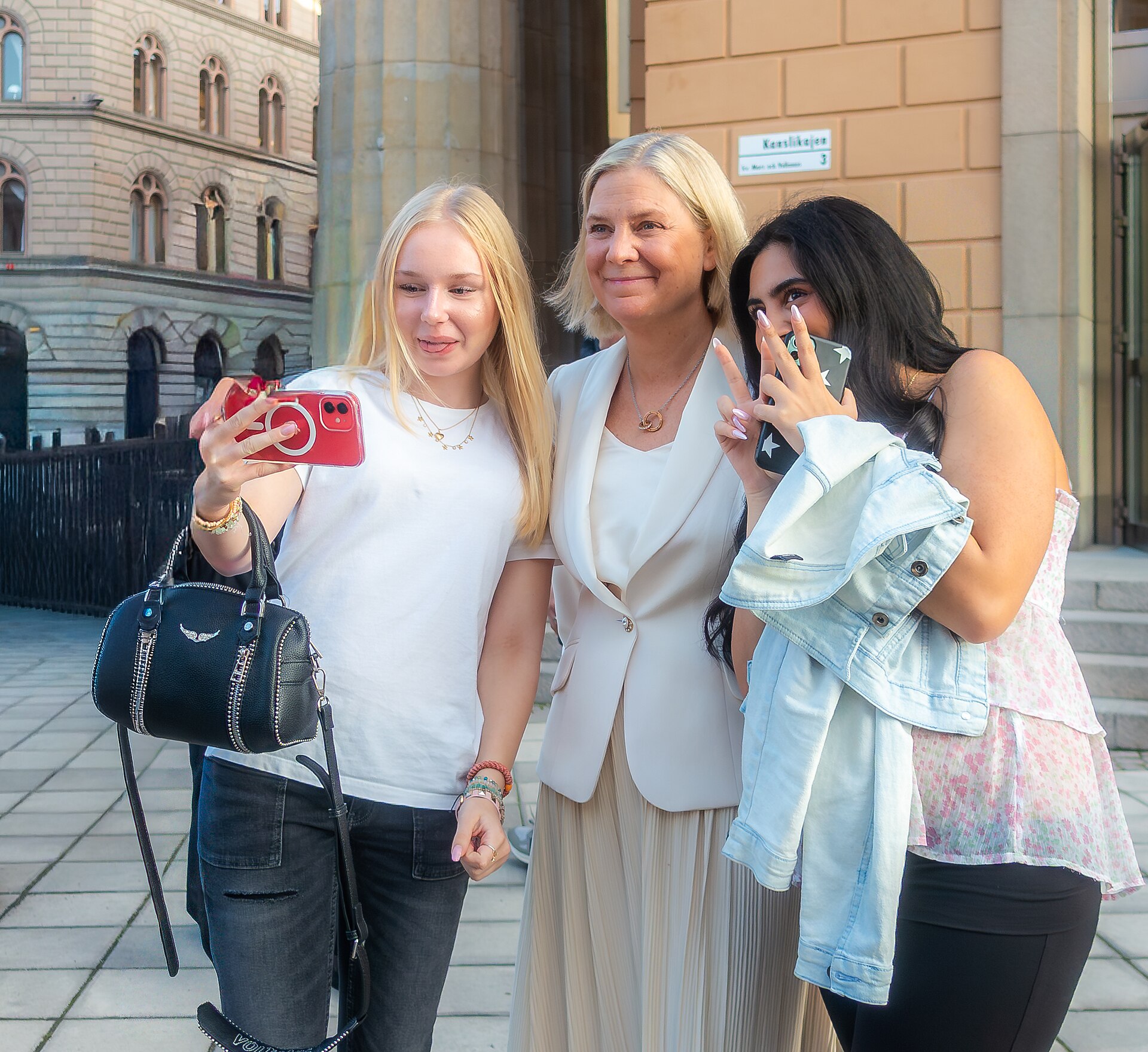
Magdalena Andersson has spent much of her public life being told that she is either too cold or too angry. The two charges should cancel each other out. Instead, they have fused into a political persona: the hard, impatient economist who can look as if she is personally offended by an incorrect spreadsheet, an evasive answer or the continued existence of a government she believes she should replace.
The description is not entirely a caricature. Former colleagues and negotiating opponents have described Andersson as direct, confrontational, easily frustrated and exceptionally certain of her own case. When SVT profiled her before she became Social Democratic leader in 2021, one former colleague said people were afraid of her. Others called her warm, loyal and highly competent. Emil Källström, then a leading Centre Party politician who had negotiated with her, offered the cleaner formulation: Andersson was clear and straight in every situation, including when that clarity produced a bad atmosphere.
That toughness has a history. Born in Uppsala in 1967, Andersson trained as an economist and moved through the machinery of the Swedish state long before most voters knew her face. She worked in the Prime Minister's Office, at the Swedish Tax Agency and as a state secretary before becoming finance minister in 2014. She held that post for seven years, through minority governments, recurring budget fights, the refugee reception crisis and the pandemic. In 2020, the International Monetary and Financial Committee chose her as its first female chair.
Her rise to prime minister was both historic and absurdly unstable. Parliament elected Sweden's first woman prime minister in November 2021, a century after women first voted in a national election. Hours later, she resigned after the government's budget fell and the Green Party left the coalition. She returned days later at the head of a one-party Social Democratic government. The farce did not diminish the fact of her appointment. It did reveal the terrain on which she would have to govern: every majority temporary, every partner capable of walking.
Russia's full-scale invasion of Ukraine supplied the gravest test of her short premiership. Andersson abandoned the Social Democrats' long resistance to Nato membership and applied alongside Finland. It was a dramatic reversal, and also an example of the quality her supporters prize most. She can change course quickly when she concludes that the facts have changed, then defend the new course as if hesitation had never been an option.
She lost power after the 2022 election, but not because her own party collapsed. The Social Democrats rose to 30.3 per cent. The right won a one-seat majority, and Ulf Kristersson became prime minister through the Tidö cooperation with the Sweden Democrats. Andersson became opposition leader with something rare in a defeated politician: the aura of a winner denied office by arithmetic.
That aura has endured. In the latest SvD/Demoskop confidence measure, published on 22 July, 47 per cent said they had fairly or very high confidence in her. Kristersson stood at 37 per cent. The Social Democrats received 31.8 per cent in the July TV4/Novus voter barometer, still clearly the largest party. Andersson enters the final election stretch as the favourite to lead the next government, although Sweden's divided opposition makes that far from automatic.
The iron has a political edge as well as a personal one. Andersson has moved the Social Democrats closer to the right on migration, criminal justice and energy while presenting the party as the defender of welfare and economic fairness. She has admitted that her pre-2022 warning against ethnic enclaves, using the word “Somalitown”, was badly expressed. Yet the broader turn remains. Critics on the left see triangulation and moral retreat. Her calculation is that voters will not entrust her with the welfare state unless they first trust her on borders, gangs and national security.
This is where the Iron Lady comparison becomes misleading. Andersson is not Margaret Thatcher in Swedish clothing. She is a social democrat who wants a more active state, stronger public services and higher contributions from people with the greatest wealth and income. Her steel is managerial and electoral rather than anti-state. She promises order, competence and protection, not revolution.
The strength contains a governing risk. Sweden's opposition stretches from the Left and Green parties to a Centre Party that rejects sharing power with the Left. A leader who projects certainty can dominate a campaign, but minority government requires partners to leave the room with dignity and enough of their own programme to survive. Andersson must prove that firmness in a negotiation is not the same as an inability to compromise.
The scrutiny of her temperament also carries an obvious gendered burden. Andersson herself argues that powerful middle-aged women are routinely described as angry. Male leaders can bark across a chamber and be called forceful. A woman who does the same is invited to explain her emotions. That double standard does not make every criticism of her leadership invalid. It does mean voters should separate the evidence of how she exercises power from the old discomfort at seeing a woman exercise it without softening the edges.
Recently, Andersson has tried to reveal more of the person behind the discipline. She credits competitive swimming in childhood with making her focused and durable. She has spoken about her father's Alzheimer's disease, therapy, family, gardening and the fact that she is funnier in private than in politics. The glimpses are real, but they do not transform the product. Her central offer is still seriousness.
That may be exactly what this election rewards. Sweden is choosing not only between policy programmes but between rival claims to control. Kristersson asks for another term to complete the Tidö project. Andersson asks voters to believe that the country can change direction without losing command of the state. Her challenge is no longer to prove that she can display emotion. It is to show what all that toughness is for, which partners she can hold together, and whether the iron that made her formidable can also make a durable government.

DailySweden
DailySweden's desk of editors, reporters, researchers and investigative journalists. We bring readers factual, truthful and objective reporting on the issues that matter to them.
Contact the editorial desk ›